BWPA. British Wildlife Photographer of the Year
(Contains 1 photo)
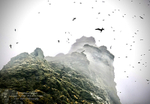
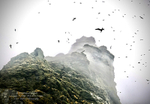 A Cacophony of Seabirds in the Mist. A Cacophony of Seabirds in the Mist.This image is published in the BWPA Book 14. 2026 A Cacophony of Seabirds in the Mist Boreray, St Kilda — June 2024 In June 2024, I boarded a small vessel operated by Kilda Cruises, departing from Leverburgh Pier, Isle of Harris at 7:45am. With a capacity of just twelve passengers, the journey promised intimacy as much as adventure. The day before, the Atlantic had been too unforgiving—our voyage postponed by rough seas—but this morning granted us passage. After a four-hour crossing, we first set foot on St Kilda, a place steeped in human resilience and isolation. Walking among the remnants of a once self-sufficient community offered a powerful glimpse into lives shaped by the sea and cliffs that surrounded them. From there, we continued onward, circling the dramatic sea stacks of Boreray. Nothing quite prepares you for Boreray—often called “The Fortress Island.” Its sheer cliffs rise abruptly from the Atlantic, soaring to heights of 384 metres, carved into jagged towers and pinnacles. Looming out of the mist, the island feels both ancient and untouchable. Here, the air was alive. Hundreds of seabirds filled the sky—gannets, puffins, fulmars, and guillemots—wheeling and calling in a restless ballet between sea and stone. Around the towering stacks of Stac an Armin and Stac Lee, the largest in Britain, the spectacle was overwhelming: a true cacophony of life against a backdrop of mist and crashing waves. These remote stacks once served as perilous hunting grounds for the people of St Kilda. Climbing their vertiginous faces, they gathered birds, eggs, and feathers—sustenance that sustained their community for generations until the evacuation of the islands in 1930. Today, their legacy lingers in the landscape, a testament to human endurance. Some 45 miles west of the Outer Hebrides, St Kilda stands as one of Britain’s most remote outposts. Recognised by UNESCO in 1986 as Scotland’s first World Heritage Site—and later awarded dual status in 2005 for both its natural and cultural significance—it remains a place where history and wild nature coexist in rare harmony. Back on the boat to Boreray, I stood outside in the wind, the sea churning beneath us. Bracing myself against the cabin, I held my camera tight, a telephoto lens pressed close for stability. Through the shifting mist, I captured fleeting moments—wings frozen mid-flight, birds suspended in the chaos of motion and sound. An unforgettable experience. Captured on a Canon EOS R6 Mark II with RF 24–240mm lens at 134mm; 1/3200 sec; f/9; ISO 2000. | (Contains 1 photo)
 |